
The Digital Leap Blueprint
A Strategic Playbook for Small Businesses to Build, Scale and Win Online
Author: simplyCommerce Research Series
Version: 2026 Edition
The Digital Leap
Blueprint
A Strategic Playbook for Small Businesses to Build, Scale and Win Online
Executive Summary
The next decade will not belong to the largest companies.
It will belong to the fastest learners.
For local businesses, artisans, retailers, manufacturers, service providers, and family-owned enterprises, digital commerce is no longer optional.
Customers discover products online before they walk into stores. They compare prices, read reviews, watch videos, ask AI assistants, and expect instant responses.
Digital economy continues to expand rapidly through increasing internet adoption, digital payments, and mobile-first commerce.
Businesses that embrace this change gain access to larger markets, increased visibility, and scalable growth opportunities.
Businesses that ignore it risk becoming invisible to the modern customer.
Why Small Businesses Struggle Online
The Traditional Challenges
Many business owners understand the need to go online but struggle with execution.
Common challenges include:
- Lack of technical expertise
- Limited marketing budgets
- Difficulty selecting the right technology
- Fear of online fraud
- Logistics and fulfillment concerns
- Inconsistent customer acquisition
- Limited content creation capabilities
- Lack of analytics and measurement
The Real Problem
Most small businesses think:
"We need a website."
The reality is:
"We need a digital revenue system."
A website alone does not create revenue.
A complete digital ecosystem does.
Without visibility, trust, conversion, and retention, even the best-designed website will fail to generate business results.
The Modern Customer Journey
The Modern Customer Journey
Today's customers follow a completely different buying process
Discovery
Research
Trust Building
Purchase
Delivery
Review
Repeat Purchase
Customers may discover your business through:
⚠️ If your business is invisible online, you effectively do not exist for a growing segment of potential buyers.
The Five-Stage Digital Transformation Model
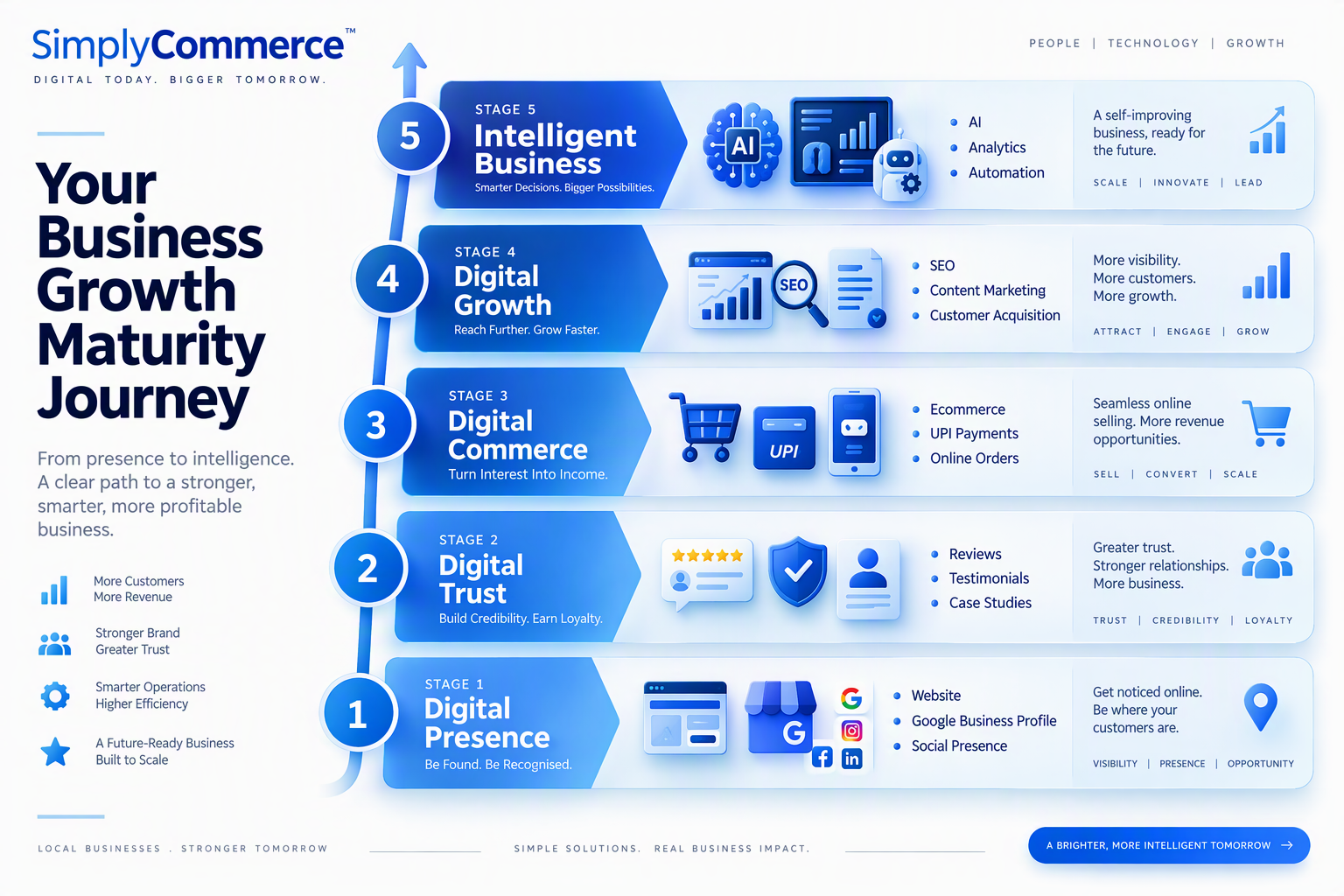
Every business progresses through these five stages.
The goal is not simply getting online.
The goal is building a sustainable digital growth engine.
Stage 1: Digital Presence
Objective
Become discoverable.
Essential Assets
- Professional website
- Google Business Profile
- Social media presence
- Business email
- Digital product catalog
Success Metric
Search visibility.
Stage 2: Digital Trust
Objective
Build credibility.
Requirements
- Customer reviews
- Case studies
- Testimonials
- Product images
- Team information
- Clear policies
Success Metric
Visitor-to-lead conversion.
Stage 3: Digital Commerce
Objective
Enable transactions.
Requirements
- Shopping cart
- UPI payments
- Credit cards
- Wallets
- Order management
- Shipping integration
Success Metric
Online revenue.
Stage 4: Digital Growth
Objective
Scale customer acquisition.
Growth Engines
- SEO
- Content marketing
- Email marketing
- WhatsApp automation
- Influencer partnerships
- Paid advertising
Success Metric
Customer acquisition cost.
Stage 5: Intelligent Business
Objective
Data-driven expansion.
Capabilities
- Analytics
- AI-assisted marketing
- Customer segmentation
- Demand forecasting
- Automated campaigns
Success Metric
Customer lifetime value.
The Digital Revenue Architecture
Framework
Digital Revenue Architecture
How modern businesses transform digital visibility into measurable growth and recurring revenue.
Website & Store
Lead Generation
Sales Conversion
Customer Success
Brand Advocacy
Growth Flywheel
Traffic → Website → Leads → Sales → Success → Advocacy → More Traffic
Every satisfied customer amplifies future growth.
Digital growth is a process, not a single activity.
Every stage contributes to long-term business growth.
Weakness in any stage reduces overall performance.
Choosing the Right Online Selling Model
Model 1: Direct-to-Consumer (D2C)
Best For
- Manufacturers
- Niche brands
- Premium products
Advantages
- Higher margins
- Customer ownership
- Brand control
Model 2: Marketplace Selling
Examples
- Amazon
- Flipkart
- Etsy
- IndiaMART
Advantages
- Faster launch
- Existing traffic
- Easier customer acquisition
Disadvantages
- Platform dependency
- Higher competition
- Lower margins
Model 3: Hybrid Commerce
Recommended for Most SMEs
Combine:
- Own website
- Marketplace presence
- WhatsApp commerce
- Social commerce
This creates resilience and multiple revenue channels.
The 12-Month Execution Roadmap
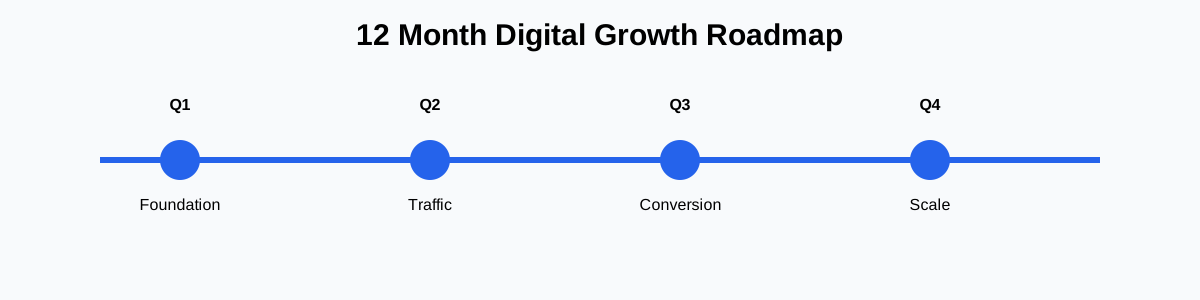
Quarter 1: Foundation
Key Activities
- Build website
- Register business profiles
- Professional product photography
- Setup online payment methods
- Setup analytics
Expected Outcome
Digital presence established.
Quarter 2: Lead Generation
Key Activities
- SEO implementation
- Content publishing
- Social media campaigns
- Google Business optimization
Expected Outcome
Consistent traffic generation.
Quarter 3: Conversion Optimization
Key Activities
- Improve landing pages
- Automate WhatsApp
- Launch email marketing
- Customer retention programs
Expected Outcome
Improved conversion rates.
Quarter 4: Scale
Key Activities
- AI tools
- Advanced analytics
- Advertising expansion
- New market penetration
Expected Outcome
Predictable growth engine.
SEO Strategy for Small Businesses
Local SEO
Critical actions include:
- Optimize Google Business Profile
- Maintain consistent business information
- Collect customer reviews
- Publish locally relevant content
Content SEO
Create valuable content such as:
- Buying guides
- Product comparisons
- FAQs
- Industry insights
- Customer success stories
Modern search increasingly rewards helpful expertise and trust.
The AI Revolution for Small Businesses
Artificial Intelligence has dramatically reduced the cost of marketing and customer engagement.
Applications include:
- Product descriptions
- Blog generation
- Customer support chatbots
- Ad copy creation
- Image generation
- Sales assistance
Small businesses can now compete with much larger organizations using automation and intelligent tools.
Digital Marketing Investment Framework
Digital Marketing Investment Framework
Suggested budget allocation for maximum ROI
Website
SEO
Content
Social Media
Paid Advertising
Analytics
Balanced approach for sustainable growth
Common Mistakes to Avoid
- Launching without analytics
- Depending on a single channel
- Ignoring customer reviews
- Poor product photography
- Lack of mobile optimization
- Slow websites
- No retention strategy
- Competing only on price
Future Trends Every SME Must Watch
- AI-powered search
- Voice commerce
- Conversational commerce
- WhatsApp-based commerce
- Video commerce
- Creator-led selling
- Hyperlocal fulfillment
- Personalized customer experiences
Strategic Recommendation
The Winning Strategy for 2026-2030
The winning strategy for a local business is:
Own Your Brand + Own Your Website + Leverage Marketplaces + Build Community + Use AI
Own Your Brand
Build a reputation that customers recognize and trust
Own Your Website
Maintain direct control over your customer relationships
Leverage Marketplaces
Use marketplace traffic for customer acquisition
Build Community
Create long-term customer loyalty
Use AI
Improve efficiency, speed, and decision-making
The Goal
The goal is not merely to sell online.
The goal is to create a scalable digital asset that generates customers, sales, trust, and growth independent of location.
About simplyCommerce
simplyCommerce helps local businesses, retailers, manufacturers, and service providers establish a profitable digital presence through ecommerce platforms, digital strategy, SEO, automation, analytics, and AI-powered growth solutions.
Our mission is simple:
Help small businesses compete without limits.
References
- OECD Going Digital Toolkit
- OECD SME Digitalisation Research
- World Bank Digital Development Publications
- World Bank SME E-commerce Research
- Bain & Company Digital Commerce Research
This article is Part 1 of the Digital Leap Blueprint Series by simplyCommerce.